
A well thought out local SEO content strategy will help your business to grow faster. Learn how to create an SEO strategy that will work for your business.
For many businesses looking to attract new customers via local SEO their focus has generally been around directory optimisation, Google Business Profiles and various locally run advertising campaigns.
These are all perfectly valid methods and absolutely effective at getting you found in local searches. However, that’s just the start of the journey if you’re really serious about dominating your local business sector by using a comprehensive local SEO strategy.
Content can play a much more effective role in local SEO and new customer acquisition than you may think. From optimising the content on your website to actively producing content for local business blogs, magazines and organisations, content marketing can and should be an integral part of your local SEO strategy.
Let’s look at how you can leverage content as part of your local SEO strategy to drive more visitors to your website and convert more of them to happy customers.
Step 1: Identify your localised keyword terms
This is the most obvious and logical place to start your local SEO strategy, identifying the keyword searches that your potential customers will be using to find your services. Having a well-researched keyword list gets you on the path to ensuring that your website will contain all of the localised search terms that you want to be found for.
Tools to help you find right terms for your business
Rather than guessing which terms are going to be best for your site, use tools such as Semrush or Ubersuggest to help you find good keyword terms to go after.
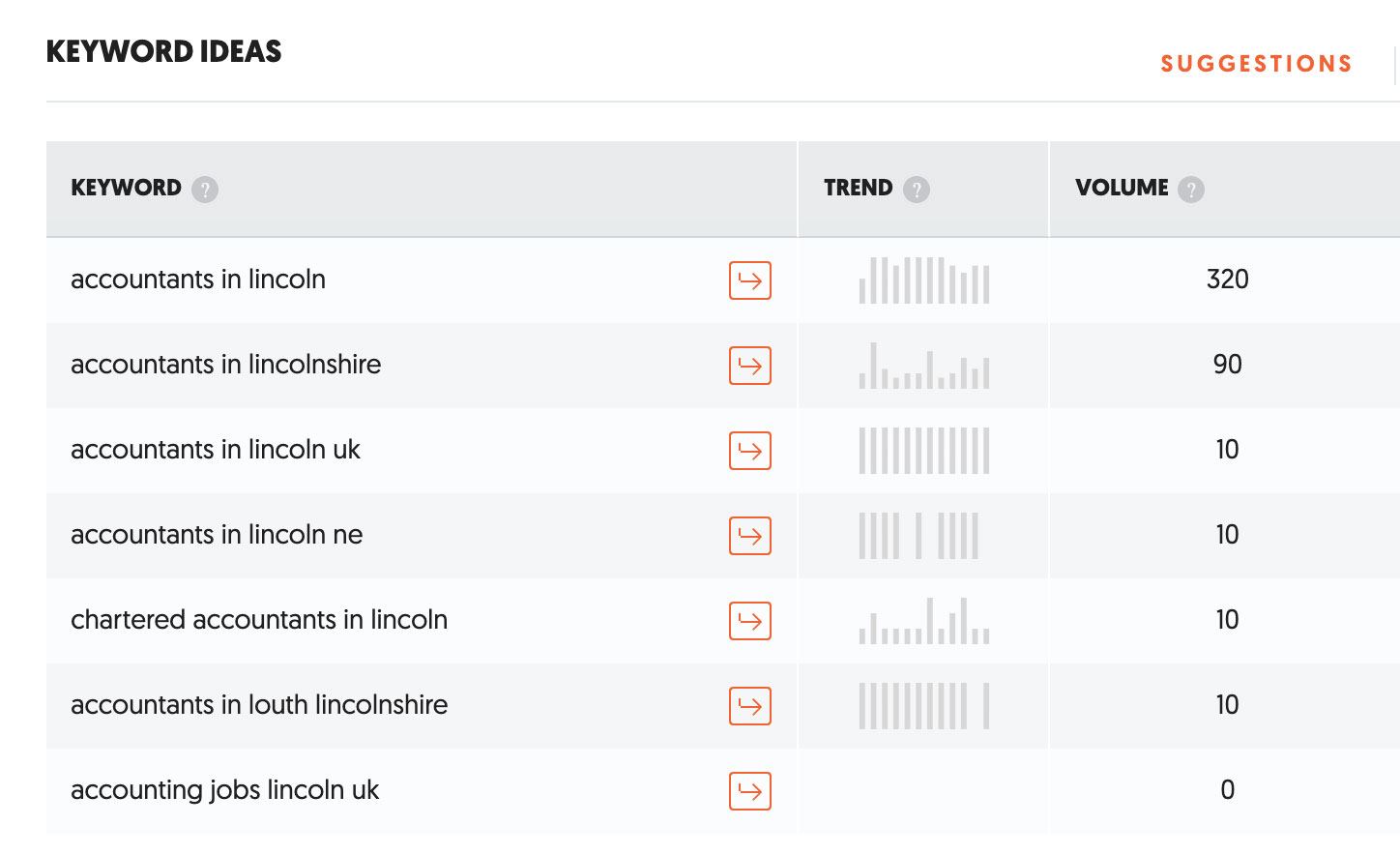
Invest some time looking for variations that are applicable to your business. In the accountant example above examples could be, small business accountants in Lincoln, self-employed accountancy services Lincoln.
One thing to be aware of, if your locality has a relatively low population, most keyword tools struggle with low volume accuracy. Just because the predicted volume looks like it’ll be next to nothing doesn’t mean it won’t work well for your business.
Keyword tools may be unlikely to record 5 or 6 searches per week, however for your business if that resulted in bringing in several significant new clients it could well make all the difference.
Step 2: Optimise your website pages
Armed with your localised list of search terms that potential customers are most likely to use you can begin optimising your website content for those terms.
Follow best practices for on-page SEO:
Keeping with best practices will help to give your content the best possible chance of ranking well.
- Include the target keyword in the page title.
- Include the target keyword in the URL
- Write a concise meta description, this can also include the keyword but it must look natural not spammy and must make sense, humans decide whether to click and the meta description is often what shows in the search results.
- Write informative, keyword rich content that the reader will feel is of benefit and value to them.
- Add relevant images with descriptive alt-text, titles and descriptions.
- Use H1,H2 and H3 headings logically throughout the page.
- Remember to link internally within the content to related pages. In addition to SEO benefits, links within the content are often more likely to get a click that complex navigation systems at the top of a business website.
Don’t double up on content, make sure you don’t produce many pages with small variations in the search term while the bulk of the content remains almost identical. Even if the wording has been changed Google is much more able to understand the bigger picture today. When Google recognises that each page effectively carries the same message with a different keyword it’s likely to discard the additional pages from the search results.
A more effective approach is to place the primary search term in the title of the page and then bring in the closely related terms within the same piece of content in a manner that is logical and feels natural to the reader.
Step 3: Create a detailed contact page
Potential customers will use your contact page to learn where you are. If they’re presented with a lone contact form and little else they won’t stay for long.
A contact page can be used to deliver valuable context for both your local SEO strategy and site visitors who want to take the conversation further.
Make sure your contact page contains the following information:
- Include your official business name.
- The trading address of your local business.
- Your hours of business.
- Google maps and any helpful additional directions to help customers find you.
- Full business contact information, phone numbers, email address, mailing address.
- A simple contact form, make it easy for visitors to send over a quick enquiry, keep the fields down to a minimum.
As well as helping visitors a well-structured contact page helps Google to verify your location and increases your chances of ranking well for local listings.
Step 4: Create local content
After creating your primary web pages and making sure that they are well optimised for local SEO you can move on to your blog.
Blogs have changed over the years, it’s true that very few people would choose to follow a business blog today, social media is a much better place for those types of actives. However, putting high value localised information on your business blog can pay dividends.
In some instances, there may be opportunities for very relevant localised content, for example, a landscaping business in a locality that experiences sharp frosts or a home insulation specialist in an area where there are many old homes that need specialist solutions.
Be creative with your blog, broaden your reach to related topics outside of your immediate market that will draw in local readers who will also become aware of the services you provide, further building your profile.
Step 5: Submit guest posts to local publications
Successful publications tend to be overwhelmed with people wanting to write guest posts on their publication, requests get ignored so you have to have a good approach.
If you were a home insulation specialist you could contact the local news paper or similar and offer to provide a full advice article for people specifically in your region with help on advice on where to source materials, what to expect to pay, how to save money etc. Only ask that you have a very small foster at the bottom that explains who you are and looks to you website.
Other local businesses may well be glad of a guest post, time pressures often lead to businesses neglecting their blogs and would be happy to receive fresh content if you approached them with a very positive idea that is beneficial for all parties.
Try to build a relationship up with the more influential local publications, become a recognised local expert with a weekly slot on a popular publication can open up a very fruitful marketing stream.
Step 6: Write about local events and activities
Every locality has events and activities that create a buzz. Getting involved in those events gives you an opportunity to be part of the buzz.
It could be a festival that takes months of planning, if you could help and contribute in some way and incorporate a timeline of progress via your website you have the opportunity to become a valuable source of local information.
Don’t make it all about what you’re doing, talk about what others are doing, feature people, add photos, interviews, make it inclusive, be creative.
Ideas for events to get involved with:
- Sporting events
- Networking events
- Conferences
- Festivals or concerts
- Seasonal fairs and events
- Local ceremonies
Step 7: Grow a local audience on social media
Depending on your business type you may have an opportunity to create a Facebook group that local people find relevant and helpful. There may already be suitable groups that you can join and become one of the more helpful users.
Be tactical, if you notice a lot of people asking similar questions that you know the answer to, write an in-depth blog post on your website with the answers they are looking for. In future when the question inevitable crops up again you can redirect them to your article. It’s a brilliant way to blow your own trumpet in a manner that doesn’t cause offence or seem too pushy.
As your reputation for being helpful grows you will almost certainly find other group members will point to you when they see questions that they know will fit your expertise.
Be helpful, share other local businesses news and information, don’t just retweet or share, include your own words and comments, become a positive voice for business in your locality.
Step 8: Audit you Local SEO for weaknesses
Your strategy is ready to launch, all you need to d now is to make sure you’re watertight and ready to sail.
Look out for the following:
- Great content that lacks local strong local keyword targeting.
- Neglecting to earn good customer reviews, just one or two Google reviews won’t be enough.
- Name inconsistency, if you trade under a different name to your business name be careful that you don’t create inconsistencies that could lead to trust issues.
- Not having directory listings, don’t be absent from where your competitors are.
- Not having a Google business profile
The long term leverage that you’ll gain from having a winning local SEO strategy can’t be overstated. It’s worth taking the time to do it right.
Step 9: Audit your website
Don’t forget to ensure that your website meets all of the standards that Google requires to rank well otherwise all your hard work and effort will amount to very little.
You can use tools like Google Console and page speed insights to see what Google makes of your site and areas where you need to improve to rank well.
Step 10: Get help when you need it
Creating a winning local SEO strategy can be a challenging and time-consuming task, this could be counterproductive if you’re running a business that already demands a great deal of your time.
The long term benefits of being the go-to business in your locality are all too obvious, finding the resources to get to that position may not be viable with your in-house resources.
At The Energy Cell, we’ve helped many businesses to create SEO strategies that deliver long term organic business growth. We can provide as much help as you require, from advice to help you get your content strategy underway to working directly with you to create a website and content marketing strategy that meets your most ambitious business goals.
You’re always welcome to call us for a chat, we’d love to hear more about your business.